Love in Practice · April 28, 2026
Why Love Is the Center of Everything: A Note From the Author
A note from JQ Botes on how reading Scripture led to seeing love beneath sin, obedience, and the church, and to writing Meaningless Without Love.
I did not set out to write a book about love.
I set out to understand the Bible better. I wanted to go deeper, to read more carefully, to understand what God was actually asking of me as a Christian. I am not a pastor. I am not a theologian. I am a man with a Bible and a growing sense that the version of Christianity I had been handed was not quite the thing the book describes.
So I started reading. Slowly. With a pen in my hand, most of the time. Marking the passages that stopped me, the verses I had skated over for years without noticing, the sentences that seemed to mean more than I had been taught they meant.
And the more I read, the more one thing kept surfacing. Quietly at first. Then impossible to ignore.
Everything kept coming back to love.
Not as one theme among many. Not as a chapter of the Christian life that sits alongside holiness and mission and obedience and prayer. As the theme beneath all the other themes. The foundation everything else was built on.
I started to see it everywhere.
The law, all of it, summarized in two commands, both of them about love. A God who called a people out of Egypt and gave them one thing to remember: love the Lord your God with all your heart and with all your soul and with all your strength, and love your neighbor as yourself. That was it. That was the hinge.
The prophets calling Israel back, always back, to a love for God they had abandoned. Every rebuke, every lament, every dire warning finally tracing back to the same charge: you have forgotten how to love me.
Jesus arriving not just to teach about love but to embody it completely. Walking among the sick and the outcast, the ashamed and the overlooked, and loving them all the way to the cross. The most powerful act of love in human history was not a feeling. It was a choice made despite enormous cost, for people who had done nothing to deserve it.
Paul writing to a divided, struggling church and telling them that without love, everything they were doing, the gifts, the sacrifice, the theology, amounted to nothing. I could preach like an angel, he said. I could give away everything I own. I could hand over my body to the flames. Without love, I am nothing. I gain nothing.
John, at the end of his life, having seen and experienced more of God than almost anyone, reducing the whole thing to three words: God is love.
The whole thing
It struck me that this was not a small insight. This was the whole thing.
Christianity is not primarily a set of beliefs to hold or rules to follow or religious practices to maintain. It is a love story. It begins with God loving a world that had turned away from Him, and ends with that love restoring everything the turning away had broken. And in between, it asks one thing of us: that we receive that love, and then give it away.
What it changed
That realization changed how I read Scripture.
It changed how I understood sin. Not as rule-breaking but as a departure from love. Every commandment God ever gave is a description of what love looks like in practice, and every sin is a refusal, somewhere, to love.
It changed how I understood obedience. Not as duty but as the natural language of a heart that genuinely loves God. You do not have to be made to love well what you are actually in love with. You do not have to be forced to treat a person kindly when you are genuinely glad they exist. Obedience is not the price of love. Obedience is how love speaks.
It changed how I understood the church. Not as an institution but as a community of people who have been given something the world cannot produce and are called to share it with everyone they meet.
Why I wrote it down
And it made me want to write it down.
Not because I have mastered it. I have not. I am somewhere in the middle of learning it, just like you. But because I became convinced, over months of reading and praying and arguing with my own habits, that many Christians are carrying a version of their faith that is heavier and more complicated than it needs to be, when the thing underneath it all is actually quite simple.
Love God. Love people. Everything else follows.
That is the sentence the book is trying to unpack. Meaningless Without Love walks through 1 Corinthians 13 one quality of love at a time, asking what each one actually requires of us. Patience. Kindness. The refusal to envy. The refusal to boast. The unwillingness to keep a record of wrongs. And then it asks the harder question of the second half: what does it look like to actually live any of this, in the people around you, in your life with God, in the places where you have been hurt most.
It is not a how-to book. It is not a seven-step program. I do not think anyone needs another one of those, and I am not qualified to write one anyway. It is a walk through the text itself, one quality at a time, trying to see what the apostle is describing and whether any of us is actually living it.
I hope, by the time you reach the final page, you are more convinced than ever that love is not one part of the Christian life. It is the whole thing. And I hope that conviction changes something in you the way it changed something in me.
The book is out now on Amazon, in paperback and Kindle. If it resonates, an honest review is the most useful thing you can give it, and nothing at all if it does not.
Either way, I am glad you are here. Thank you for reading this far.
More next week.
JQ
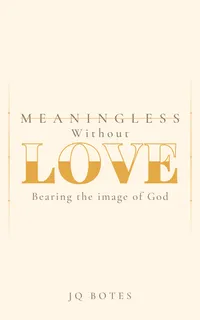
From the book
Meaningless Without Love
A walk through 1 Corinthians 13 one quality of love at a time, asking what each one requires of us. Available now.
Read the book →The newsletter
one_article_a_week
If this one was useful, there is one like it every week. Short writing on love, faith, and what it actually looks like to live what you say you believe. No spam, no upsells.
Thank you. You will hear from me soon.
Something went wrong. Please check your connection and try again.